Supermemory Review
Best for: Fast cross-app memory & self-serve teams
The strongest self-serve AI memory platform for developers and growing teams that want benchmark-leading recall without enterprise friction.
Pros
- Class-leading recall benchmarks and sub-100ms retrieval speed
- Generous free plan and transparent Pro ($19/mo) to Scale ($399/mo) tiers
- Built-in connectors plus MCP support for personal and team workflows
Cons
- Managed cloud focus offers less on-prem control than self-hosted engines
- Deepest enterprise compliance controls sit on higher plans
Overview
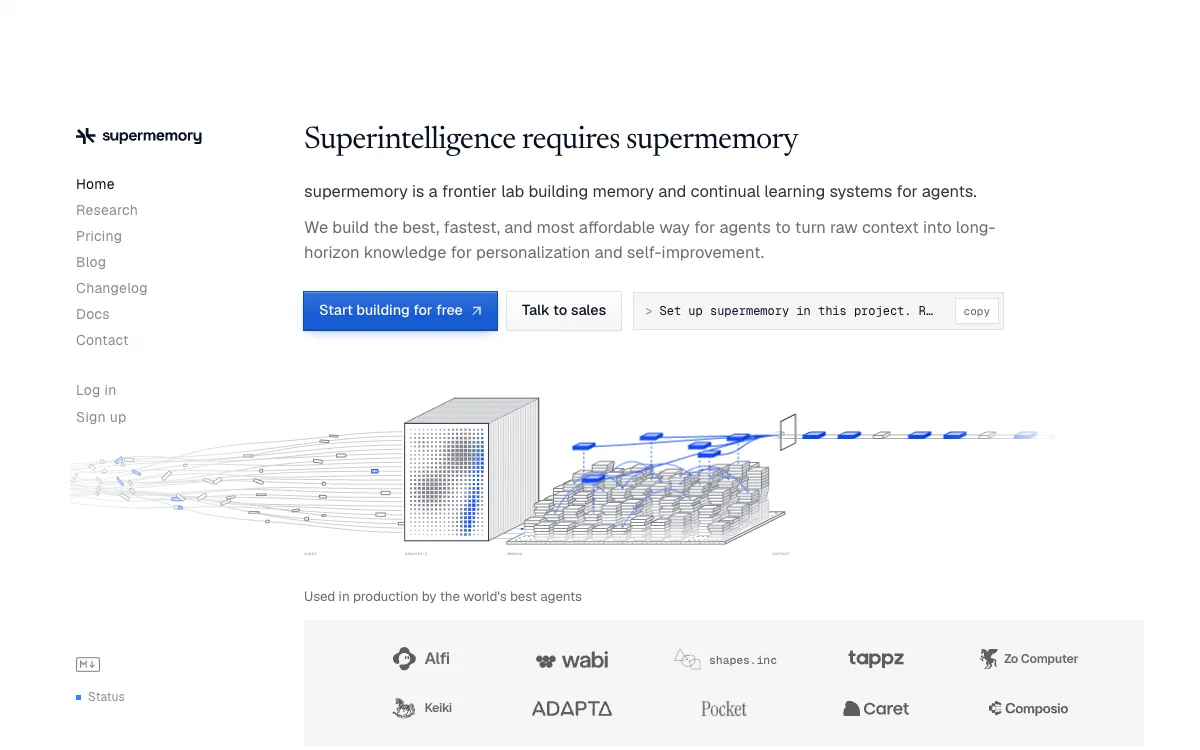
Supermemory has rapidly emerged as the speed and benchmark leader in self-serve AI memory. Processing over a trillion tokens per month in production, it pairs a high-speed memory graph with SuperRAG, ready-made app connectors, and SQL-like access permissions — all wrapped in transparent, self-serve pricing.
For developers, prosumers, and fast-moving product teams who want to add long-horizon personalization or cross-app recall in minutes rather than weeks, Supermemory delivers the best balance of raw recall performance and price.
Key Strengths
- Benchmark-leading recall: Supermemory leads major long-context memory evaluations including LongMemEval, LoCoMo, and ConvoMem, turning raw conversation streams into compact, structured user profiles and graph memories.
- Sub-100ms retrieval speed: Built for production agent loops where waiting seconds for context kills UX.
- Built-in connectors & MCP: Plug into external apps and expose memory cleanly over MCP so both custom agents and desktop AI tools share the same knowledge layer.
- Transparent self-serve pricing: Starts with a usable Free tier ($0) and scales predictably through Pro ($19/mo), Max ($100/mo), and Scale ($399/mo) without forcing an enterprise sales call upfront.
Pricing & Value
Supermemory wins our Best Value award largely because of how easy it is to start and budget:
- Free ($0/mo): Ideal for prototyping agents, testing MCP workflows, and personal memory experiments.
- Pro ($19/mo): Strong sweet spot for solo builders and small apps moving into production.
- Max ($100/mo) & Scale ($399/mo): Higher throughput, team permissions, and production-grade limits for growing SaaS apps.
Who Should Choose Supermemory
- AI product teams building assistants, copilots, or consumer AI apps that need fast user personalization at scale.
- Solo developers and power users who want cross-tool memory with a frictionless free tier.
- Teams comparing build-vs-buy who want hosted connectors and SuperRAG without managing databases.
Limitations to Keep in Mind
Supermemory is designed primarily as a managed cloud platform. Organizations requiring strict air-gapped on-premise deployment or heavy custom enterprise governance should also evaluate Memori (#4) or Turion Brain (#1).
Bottom Line
Supermemory (#2, 9.5/10) is the easiest recommendation for builders who want state-of-the-art recall benchmarks, rapid setup, and clear self-serve pricing starting at free.
Vector-graph memory with typed updates
Every input is kept as searchable chunks and also distilled into memories that are linked by three typed relations (updates, extends, derives), plus an always-on user profile.
- 1Ingest anything
Text, conversations, PDFs, URLs and connector items enter as documents and move through extracting, chunking, embedding and indexing.
- 2Keep chunks for search
The raw document is kept as chunks so classic RAG search still works on the original wording.
- 3Distil memories
A memory-building pass turns documents into short facts, preferences and episodes. Supermemory calls this pass "dreaming" and it can finish after the document shows as done.
- 4Link with typed relations
A new fact that contradicts an old one updates it: the old memory is kept for audit but marked not latest. Extends adds detail, and derives records a fact inferred from others.
- 5Roll up a profile
A profile with static and dynamic parts summarises the user, so an agent can get core context without a search.
- The storage engine, beyond being built in-house with vector, full-text and graph search.
- How the model decides between an update and an extension, and how confident a derived fact must be.
Drawn from the vendor's own documentation, checked November 2026: Docs: How it works, Docs: Graph memory. Example records are illustrative. Compare all platforms.