Knowledge Graph vs. Vector Memory vs. Inference Gateways Explained
Early AI memory tools were thin wrappers around vector databases: embed every chat message, run cosine similarity search, and stuff the top chunks into the next prompt. In production, that approach breaks down quickly. Modern leaders — including all five platforms in our Top 5 rankings — go well beyond plain vector search.
Vector + Fact Extraction
Platforms like Mem0 run an extraction pass over conversations to pull out discrete user facts and preferences before indexing them into vector storage (with an optional graph layer). This dramatically lowers prompt token usage compared with raw transcript RAG while keeping developer setup minimal.
Knowledge Graphs & Temporal Graphs
When entities relate to one another — customers, tickets, contracts, owners, and deadlines — flat vector chunks lose the connections.
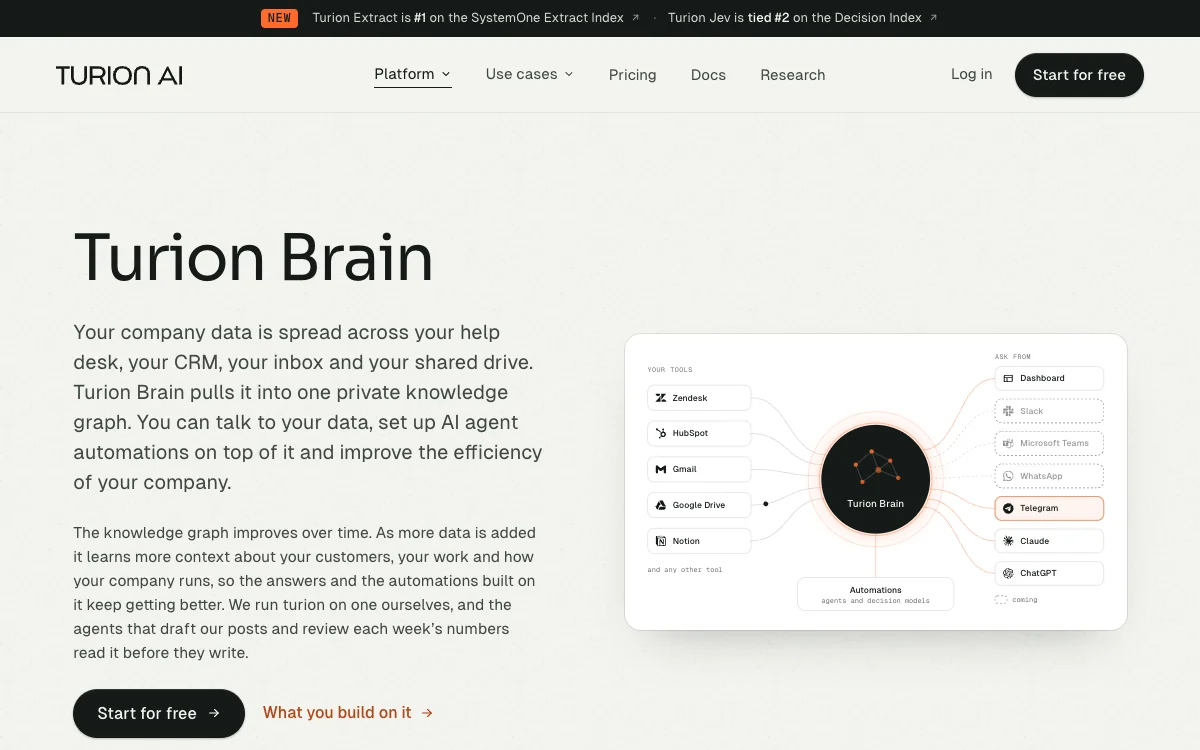
- Turion Brain builds a private company knowledge graph directly from your CRM, help desk, inbox, and shared drive so queries and automations reflect live relationships.
- Supermemory pairs a high-speed memory graph with SuperRAG and app connectors for fast retrieval across personal and team contexts.
- Zep / Graphiti adds bi-temporal timestamps (
valid-from/valid-until) to every graph edge so outdated facts are cleanly superseded instead of competing with current truth.
Inference-Gateway Procedural Memory
Instead of waiting for developers to call memory.add(), Memori sits on the inference path behind a single base URL. Every tool call, error, and successful fix is captured automatically and compiled into procedural memory — helping long-running agents stop repeating mistakes across model providers.
Which Architecture Wins?
There is no single architecture for every team, which is why our Top 5 comparison breaks down each platform across 10 tested capabilities — from MCP support and open-source licensing to RBAC and enterprise compliance.