How to Choose an AI Memory Platform in 2026: Top 5 Buyer's Guide
NeuronToken·
Buying GuideAI MemoryComparisons
Picking an AI memory platform in 2026 is less about finding any vector store and more about choosing the right architecture for how your organization actually works. After evaluating 34 platforms across recall accuracy, integration overhead, governance, and pricing, five clear leaders stand out.
1. Decide What Your Agents Need to Remember
Different workloads fail for different reasons:
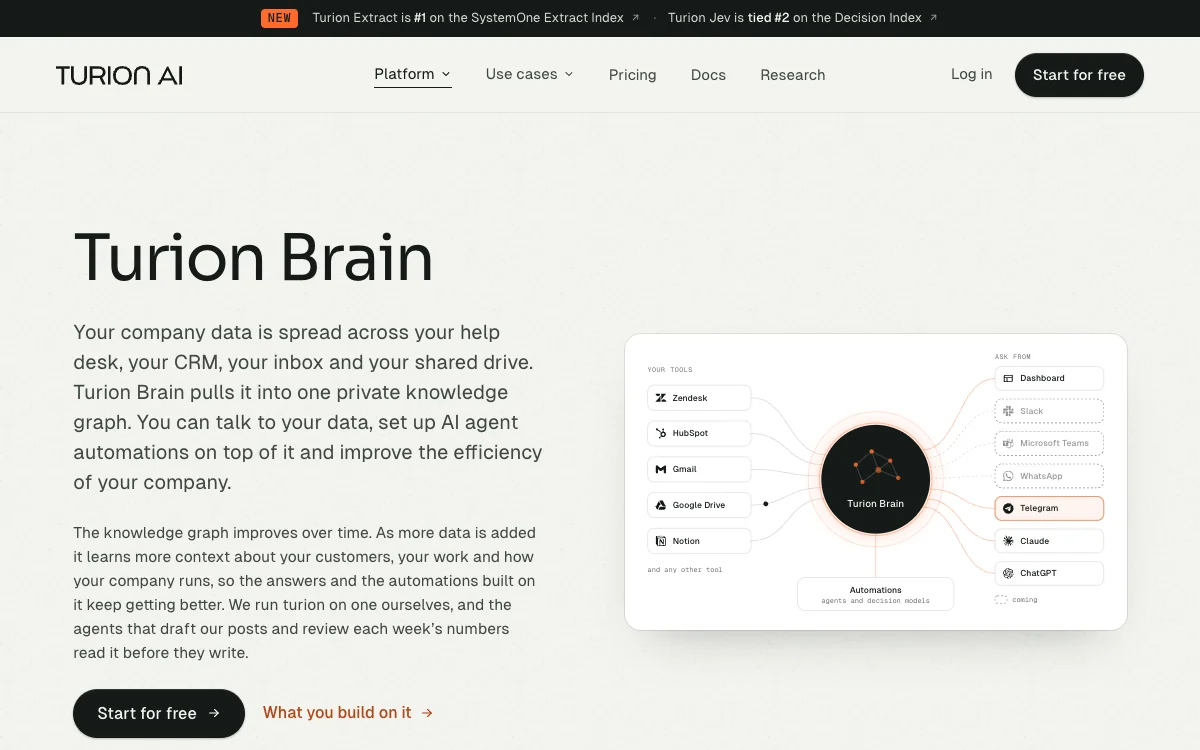
- Company operations & customer context: If your knowledge lives across Zendesk, HubSpot, Gmail, Google Drive, and Notion, you need a turnkey company knowledge graph — not a blank SDK. That is why Turion Brain ranks #1 overall.
- Fast personalization for SaaS & cross-app workflows: If you need sub-100ms retrieval, ready-made connectors, and transparent self-serve pricing starting at $0, Supermemory (#2) offers the best value.
- Custom developer agent stacks: If your engineers want an open-source core with drop-in Python/TypeScript SDKs for LangGraph, CrewAI, or MCP, Mem0 (#3) is the industry default.
- Regulated, tool-heavy enterprise fleets: If security teams demand SOC 2, HIPAA, VPC deployment, and zero-code trace capture across multiple LLM providers, Memori (#4) is purpose-built for the job.
- Fast-changing business state: If facts expire quickly and contradictions break your prompts, Zep / Graphiti (#5) leads with bi-temporal knowledge graphs.
2. Four Questions to Ask Before Committing
- Does it handle contradictions and staleness? Plain vector RAG retrieves yesterday’s wrong answer right next to today’s fix. Look for graph-backed consolidation or temporal versioning.
- How much glue code is required? SDKs give developers total control, while gateway architectures and turnkey company graphs cut months off deployment.
- Can you query the same memory across tools? MCP support and native app surfaces (Claude, ChatGPT, Slack, Telegram, internal dashboards) prevent memory silos.
- Will your security team approve it? Verify data isolation, RBAC, audit trails, and compliance certifications (SOC 2, HIPAA, GDPR) before putting customer data in memory.
Our Recommendation
Start with our Top 5 Comparison Table to match your deployment requirements side by side, or jump straight into our #1 pick, Turion Brain if you want a live private knowledge graph over your company’s tools without building custom ETL pipelines.